+1 888 608-7511
Need help finding a standard?
Help Desk
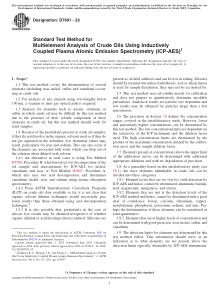
1.1 This test method covers the determination of several elements (including iron, nickel, sulfur, and vanadium) occurring in crude oils.
1.2 For analysis of any element using wavelengths below 190 nm, a vacuum or inert gas optical path is required.
1.3 Analysis for elements such as arsenic, selenium, or sulfur in whole crude oil may be difficult by this test method due to the presence of their volatile compounds of these elements in crude oil; but this test method should work for resid samples.
1.4 Because of the particulates present in crude oil samples, if they do not dissolve in the organic solvents used or if they do not get aspirated in the nebulizer, low elemental values may result, particularly for iron and sodium. This can also occur if the elements are associated with water which can drop out of the solution when diluted with solvent.
1.5 This test method uses oil-soluble metals for calibration and does not purport to quantitatively determine insoluble particulates. Analytical results are particle size dependent and low results may be obtained for particles larger than a few micrometers.
1.6 The precision in Section 18 defines the concentration ranges covered in the interlaboratory study. However, lower and particularly higher concentrations can be determined by this test method. The low concentration limits are dependent on the sensitivity of the ICP instrument and the dilution factor used. The high concentration limits are determined by the product of the maximum concentration defined by the calibration curve and the sample dilution factor.
1.7 Elements present at concentrations above the upper limit of the calibration curves can be determined with additional appropriate dilutions and with no degradation of precision.
1.8 As a generality based on this interlaboratory study (see 18.1), the trace elements identifiable in crude oils can be divided into three categories:
1.9 The detection limits for elements not determined by this test method follow. This information should serve as an indication as to what elements are not present above the detection limits typically obtainable by ICP-AES instruments.
|
Element |
mg/kg |
|
Aluminum |
1 |
|
Barium |
0.2 |
|
Boron |
1 |
|
Calcium |
0.1 |
|
Chromium |
0.1 |
|
Copper |
0.1 |
|
Lead |
1.4 |
|
Magnesium |
1 |
|
Manganese |
0.1 |
|
Molybdenum |
0.2 |
|
Phosphorous |
1 |
|
Potassium |
0.5 |
|
Silicon |
1.1 This test method covers the determination of several elements (including iron, nickel, sulfur, and vanadium) occurring in crude oils.
1.2 For analysis of any element using wavelengths below 190 nm, a vacuum or inert gas optical path is required.
1.3 Analysis for elements such as arsenic, selenium, or sulfur in whole crude oil may be difficult by this test method due to the presence of their volatile compounds of these elements in crude oil; but this test method should work for resid samples.
1.4 Because of the particulates present in crude oil samples, if they do not dissolve in the organic solvents used or if they do not get aspirated in the nebulizer, low elemental values may result, particularly for iron and sodium. This can also occur if the elements are associated with water which can drop out of the solution when diluted with solvent.
1.5 This test method uses oil-soluble metals for calibration and does not purport to quantitatively determine insoluble particulates. Analytical results are particle size dependent and low results may be obtained for particles larger than a few micrometers.
1.6 The precision in Section 18 defines the concentration ranges covered in the interlaboratory study. However, lower and particularly higher concentrations can be determined by this test method. The low concentration limits are dependent on the sensitivity of the ICP instrument and the dilution factor used. The high concentration limits are determined by the product of the maximum concentration defined by the calibration curve and the sample dilution factor.
1.7 Elements present at concentrations above the upper limit of the calibration curves can be determined with additional appropriate dilutions and with no degradation of precision.
1.8 As a generality based on this interlaboratory study (see 18.1), the trace elements identifiable in crude oils can be divided into three categories:
1.9 The detection limits for elements not determined by this test method follow. This information should serve as an indication as to what elements are not present above the detection limits typically obtainable by ICP-AES instruments.
|
Element |
mg/kg |
|
Aluminum |
1 |
|
Barium |
0.2 |
|
Boron |
1 |
|
Calcium |
0.1 |
|
Chromium |
0.1 |
|
Copper |
0.1 |
|
Lead |
1.4 |
|
Magnesium |
1 |
|
Manganese |
0.1 |
|
Molybdenum |
0.2 |
|
Phosphorous |
1 |
|
Potassium |
0 |
5.1 Most often determined trace elements in crude oils are nickel and vanadium, which are usually the most abundant; however, as many as 45 elements in crude oils have been reported.
Knowledge of trace elements in crude oil is important because they can have an adverse effect on petroleum refining and product quality. These effects can include catalyst poisoning in the refinery and excessive atmospheric emission in combustion of fuels.
Trace element concentrations are also useful in correlating production from different wells and horizons in a field. Elements such as iron, arsenic, and lead are catalyst poisons. Vanadium compounds can cause refractory damage in furnaces, and sodium compounds have been found to cause superficial fusion on fire brick.
Some organometallic compounds are volatile which can lead to the contamination of distillate fractions, and a reduction in their stability or malfunctions of equipment when they are combusted.
5.2 The value of crude oil can be determined, in part, by the concentrations of nickel, vanadium, and iron.
5.3 Inductively coupled plasma-atomic emission spectrometry (ICP-AES) is a widely used technique in the oil industry. Its advantages over traditional atomic absorption spectrometry (AAS) include greater sensitivity, freedom from molecular interferences, wide dynamic range, and multi-element capability. See Practice D7260.
Failed to load document history.
| Publish Date | Document Id | Type | View |
|---|