+1 888 608-7511
Need help finding a standard?
Help Desk
Following the long-standing tradition of fib in promoting the use of consistent design methods, strut-and-tie models were formally incorporated in Model Code 1990 to serve as the design basis for discontinuity regions. This choice was largely acknowledged as a sound approach for design and was thereafter followed in many national standards. For Model Code 2010, some update and revision of the previous provisions was performed, but the scope of the method was particularly broadened by introducing its complementary use with the stress field method.
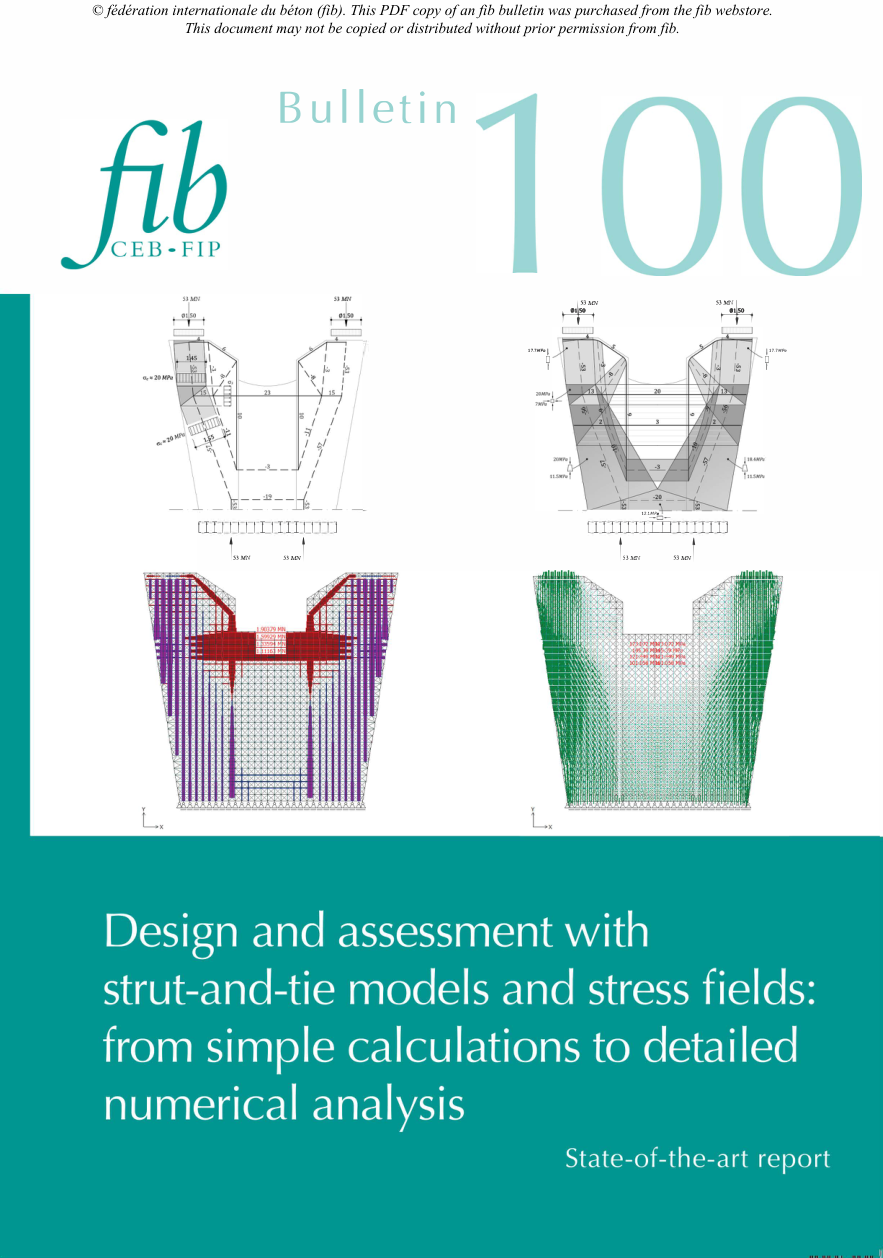
Since Model Code 2010, significant new knowledge has been generated in this topic. Particularly, the use of software implementing the theoretical ground of the stress field method is becoming increasingly popular and efficient, allowing for design, optimisation and assessment of structures in a simple, transparent and accessible manner.In this Bulletin, the current state-of-the-art of the strut-and-tie models (STM) and the stress field models (SFM) is presented. Reference is not only made to classical rigid-plastic solutions, but also to solutions considering compatibility of deformations, such as elastic-plastic approaches or models allowing investigation of serviceability behaviour and deformation capacity of concrete structures.
It is shown in the Bulletin that all models share the same ground and fundamental hypotheses. Their results are presented in a unitary and consistent manner by means of compression fields in the concrete and stresses in the reinforcement. The consistency amongst these approaches and their potential use in practice is also explored by means of the Levels-of-Approximation (LoA) approach as described in Model Code 2010.Another effort in this Bulletin has been devoted to provide comparisons of the solutions according to strut-and-tie and stress fields to tests, in order to discuss on their pertinence and limitations.
This perspective is also completed with practical examples presented of structures actually designed with this technique and where the potential of these methods can be appreciated in a clear manner. Finally, a number of special topics are also covered in the Bulletin, related to numerical optimisation, verifications at serviceability states, minimum reinforcement or the applicability of the methods under cyclic or reversal actions.This Bulletin not only aims to give state-of-the-art rules and methods to design according to these techniques, but also to provide an outlook of how these methods could be implemented in future standards. This material also serves as the background document for the revision of the current provisions of Model Code 2010 in the new Model Code 2020.Download thecopyright page (= list of authors) as a PDF file.
Failed to load document history.
| Publish Date | Document Id | Type | View |
|---|